Showing posts with label Lord of the Rings. Show all posts

Wednesday, December 18, 2013

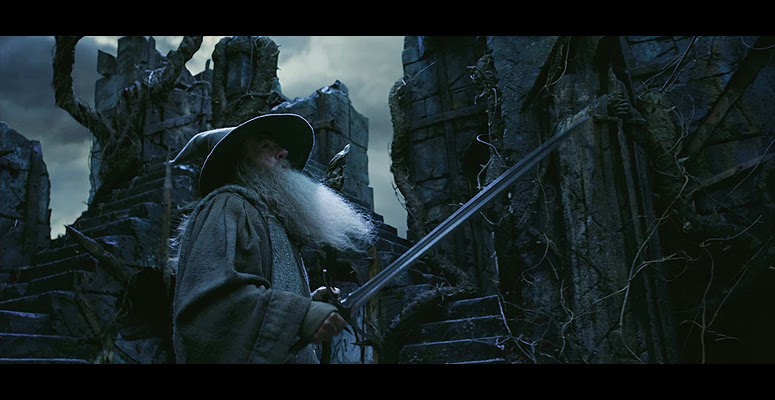
The Hobbit: The Desolation of Smaug - Review

I have seen the second Hobbit film twice.  Here are my thoughts so far, in a semi-structured order.
  • Martin Freeman is still excellent.  I feel this needs emphasising, otherwise it will be overlooked.  He is currently the stand-out feature of these films.  The way he portrays Bilbo is...I want to say perfect.  I can't think of anything wrong with it.  He is incredible.
  • The whole Beorn sequence, so memorable from the book, was very nicely adapted and really well done.  However, it felt short and rushed.  More time could have been spent developing Beorn's character, especially as he will return later, and also the dwarves characters (more on this later).
  • The references to LOTR, such as Jackson's cameo at the start and the line about athelas being a weed, are still making me smile.
  • Tauriel's inclusion was fine.  I don't care if she wasn't mentioned in the book.  There would have been elves like her, in her role within the community.  There's nothing wrong with putting her character in to help develop the story.
  • Linked in with this, I was in favour of having the orcs continue to hunt the dwarves.  I wasn't sure about this at first, but I think it keeps the pace of the story going, and it will link in nicely with Azong's return in film 3.
  • The Tauriel/Legolas romance was understandable but needed to be done properly or not at all.  I felt it was not developed sufficiently to carry weight.  Instead, time was given to the Tauriel/Kili relationship.  Now this was a farce.  No way this would have happened.  Tauriel wouldn't have got into that sort of conversation with a dwarven prisoner.  Dwarves and elves are still at loggerheads at this point in the story.  And the sheer number of times she saved his life started to annoy me.
  • The barrels sequence was good, but over the top.  It was fun, but took it all too far.  Legolas' dwarf surf?  Bombur's barrel bounce?  They're clearly trying to make these films 'entertaining' by throwing in ludicrous stunts, forgetting that stunts and effects aren't that impressive these days, now that you can put anything on screen and make it look realistic.  Impressive filming nowadays is about clever adaptation, a gripping story and engaging characters.
  • The Dol Guldur scenes were great.  Gandalf vs Sauron, awesome.
  • Laketown looked absolutely perfect.  Wonderful design.
  • There wasn't enough development of the Master of Laketown.  In fact, there wasn't enough development of the characters in general, but particularly of the Master.  I wanted more backstory about his rule over the town.
  • Smaug looked brilliant.  He was brilliant all round - the voice, the design, the animation, everything.  Lots of people have said this, but it's still true.
  • The Bilbo/Smaug scene was brilliant  Possibly even as good as riddles in the dark.  The tension was incredible.
  • I'm not convinced by the decision to leave 4 dwarves in Laketown.  It feels like it was only done to promote the Kili/Tauriel thing.  It did give the end of the film a kind of double-focus - the Lonely Mountain and Laketown - and allowed intercutting between them.  But my jury is still out on this one.
  • I think there was too much fighting in Laketown.  As I said above, I'm fine with the continuing orc-chase, but the fighting in Laketown got a bit ridiculous.  It was over-emphasised at the very least.  Yes, it provided a good second climax to the Smaug action (see above point) but I guess it felt unbalanced.
  • Dwarves vs Smaug.  Ludicrous.  Ridiculous.  Unnecessary.  Unconvincing.  As 'Mithril' from theonering.net said, "what made me cry out upon leaving the theatre 'I want a do-over' was the Indiana ones escapade that they were taken on.  Not only was it completely outrageous but it was confusing and unbelievable.  Start the forges?  What?  Melt millions of gallons of gold in minutes?  What?  Stand on the nose of Smaug 'Oh, greatest of calamities' and not get eaten?  WHAT!!?!?!?!????!"  Quite.  It was a farce.  And what was the deal with the massive gold statue at the end?  Was that there from the past?  Did they just make it?  Was it explosives that blew it up?  What made it melt?  A flipping joke.
  • Ed Sheeran's closing song was good.  Not on the level of the Rings credit songs, but still good.  I enjoyed it.
  • The music was, overall, less noticeable than in Rings or An Unexpected Journey.  I'm not sure why.  Fewer new themes perhaps?
  • Most of the dwarf characters were still undeveloped.  Thorin, Balin, Dwalin, Kili and Bofur excepted.  Bombur still hasn't had a line.  It was about 5 hours into the trilogy before we found out Fili is heir to the throne.  Too much time is spent on foolish 'action' sequences and not enough on character and story.  The way they have made them all look unique is outstanding, but this has not been replicated in terms of character development.
  • Smaug should have died.  They ended the film in the wrong place.  Instead of the disastrous action scenes inside the mountain, and the mostly unnecessary elves vs orcs in Laketown, they should have had Smaug attack Laketown as he does in the book.  It would have been a wonderful set piece, and would have eliminated the issue of having the dwarves split up.
  • Alternatively, cut some of the stupid action, including the Lonely Mountain fiasco, and spend more time on characters (including Beorn and the Master).  The problem with this would be the lack of a conventional climax to film 2.
  • These hobbit films, despite their problems, are the most impressive adaptation I have come across.  To adapt a children's book into a catch-all film, link it pretty seamlessly to a previously made epic and very popular film trilogy, and draw in multiple other Middle-Earth storylines like dwarven history and the rise of Sauron, is truly remarkable.
  • There were several glaring continuity errors.  The most obvious was how Bombur destroyed his barrel and then jumped back into it, seemingly as good as new.  Two others that annoyed me were the spontaneous appearance of a horse in Laketown, which until that point appeared to contain no horses, just in time for Legolas to ride it; and how the gold in the Lonely mountain was conveniently melt-able when the dwarves needed it to be, but didn't melt at all when Smaug breathed fire on it.
I don't really know what to write in summary.  It's a great film.  Some of it is jaw-droppingly good (e.g. Smaug, Dol Guldur, Beorn, Freeman).  Some of it is overly ridiculous (Kili/Tauriel, Dwarves vs Smaug).  It's still the greatest adaptation I have seen, and because of the difficulty of the adptation, my criticisms should be taken with a pinch of salt - especially as this is the notoriously difficult middle film.  Bring on part 3.

Wednesday, December 19, 2012

The Hobbit: review

Here are my thoughts, in a slightly structured but slightly random order.  I will try to limit comments on large scale adaptation of the book until I've seen all three films in a couple of years.  Spoilers follow.

  • I've seen the film in 2D and 3D.  3D still does not impress me - it just costs a bit more and makes my eyes hurt a bit.  I expect that 3D IMAX would be very impressive, but I haven't seen it.  I also haven't seen the film in 48fps, so I can't comment much on it - but I expect it looks good and I expect it to become the cinematic norm.
  • It was great to see Ian Holm and Elijah Wood in the film.  It helps to connect the film to LOTR.  I actually teared up when these two came on screen.
  • Martin Freeman is perfect.  I expected him to be very good, but he exceeded my expectations.  Simply outstanding.  He's a very capable serious actor but also has a great deadpan humour about him.  Sometimes it was just like watching him in The Office (in a good way).
  • New Zealand looks, if anything, even more spectacular than it did in LOTR.  Some of the wide shots are stunning.
  • The soundtrack is brilliant, both in it's own right and in the way it connects to the LOTR soundtrack.  Howard Shore, I salute you.
  • All three LOTR films started with some sort of prologue, and the first Hobbit film followed the pattern.  It worked really well, especially with Ian Holm's Bilbo narrating it.  I also liked the bonus prologue section later on detailing Azog and Thorin's enmity (more on Azog later).
  • The party scene was an excellent to introduce the dwarves.  It was full of humour but also meaty exposition.  It started to paint the picture of dwarven culture.  And it had some really good camerawork too.
  • Riddles in the dark was superb.  Everything I'd hoped for.  It's one of my favourite scenes from any book, and I was not let down.  I've already said how good Freeman is, and Serkis is, of course, a master.
  • The action sequences were sometimes a bit ridiculous.  The troll fight was good, as was the battle outside Moria, but the storm-giants scene and the escape from goblin-town were ludicrously overdone.  The storm-giants scene was unnecessary, and there was little chance anyone would have survived such an encounter, let alone all 15 of them.  Similarly, sequences in goblin-town were very unconvincing, especially with respect to the survival rate of the heroes.  One reviewer described these scenes as "extended, jovially bloody battle between dwarves and goblins, larded with visual jokes involving decapitation, disembowelment, and baddies crushed by rolling rocks. The sequence is more like a body-count video game than like anything in the sedate novel, where battles are confused and brief and frightening, rather than exuberant eye-candy ballet."
  • The warg attack was excessive and unnecessary.  It slowed the story down.  They could have just let Radagast go back to keep an eye on Mirkwood, and have Gandalf convince Thorin to go to Rivendell to check out the map.
  • One common criticism has been that the dwarves are just a bunch of personality-less simulacrums.  To an extent I agree with this.  I think Dwalin, Balin, Fili and Kili are distinct, partly because they arrive at the party in small groups, and Bofur is too, because he has an enlargened role and everyone always remembers James Nesbitt.  But the others lack screen time as individuals and lack opportunities to show themselves.  I can understand that a viewer would struggle to identify with many of them, especially if they hadn't been following the film's developments in advance.  I think Jackson could have spent more time with the dwarves, developing their characters, and cut the warg attack.
  • The troll scene good - funny but also perilous, and another chance to see the dwarves in action just being dwarves - as I just mentioned, the film needed more of this.
  • I liked the Radagast/Necromancer stuff.  It added an extra level of plot and peril above what was going on in the dwarves' quest, and it helped to start linking the film to LOTR.
  • Azog's role was changed from the book.  This was good.  It helped expand Thorin's role and added an extra elements of suspense.  It also provided this first film with a climax - much like the character or Lurtz did for FOTR.  More on Azog here.
  • The use of the orc language confused me.  In LOTR, orc and uruk-hai use the common tongue - not precisely accurate, but it makes sense from a simplicity point of view and makes the film easier to watch.  In The Hobbit, orc spoke their own language (subtitled) while on their own, and used the common tongue in scenes with dwarves.  This just seemed inconsistent with LOTR, which is a shame while most of the film is consistent.  It would have been better to just keep the orcs using the common tongue.
  • Gandalf's magic seemed inconsistent especially compared with LOTR.  He uses his magic a lot more in The Hobbit, or at least a lot more overtly.  Which begs the question, why didn't he use it more in LOTR.  Again, this is a consistency issue between the two trilogies.  It will be interesting to see what happens in parts 2 and 3.
  • I think they chose a good point at which to break the film - between the eagles and Beorn.
  • When Thorin charges Azog at the end of the film, the music playing is the Nazgul theme.  This baffled me.  I have no idea why they did this.  Anyone care to suggest a reason?
  • FOTR was practically the perfect film.  It had no weaknesses.  This wasn't as strong an opening to a trilogy as that was, but this was nevertheless an excellent film.  And I expect that the extended edition will include more dwarvishness, which I will enjoy.
  • Overall - a great film and excellent adaptation.  A very promising start to the trilogy indeed.  A bit to action-heavy for me, and the action that was there was sometimes over the top.  But other than that I have very few complaints.  My film of the year, perhaps?  That list will come soon.

Friday, April 27, 2012

The Middle-Earth Eagle Postal Service...or not


This is a question which I’ve been asked many times, and have got bored of explaining.  It came up again a few days ago so I thought I’d write about it, so that next time someone asks, I can say the wonderful line ‘I refer you to my blog’.

The question is: “In The Lord of the Rings, why didn’t the eagles fly the ring to Mordor?”

The answers are multiple.

Firstly, as Gwaihir (King of the Eagles) himself says in Fellowship part 2 chapter 2 (The Council Of Elrond), the eagles were “sent to bear tidings not burdens”.  The eagles had been ‘devised’ by Manwe, one of the Valar (a former race living in the world of middle earth), in the First Age (LOTR taking place at the end of the Third Age).  They were spies and messengers, not transportation.
Although Gwaihir carried Gandalf a few times, that was on the level of a personal favour, and only over short distances.

On a more practical note, the whole point of taking the ring on foot was to keep the mission as secret as possible.  Had Gandalf, or anyone, attempted to take the ring on an Eagle, it would have been seen easily by Sauron and/or the Nazgul, and would have been taken out with arrows or fell beasts.

Some people have suggested that the eagles would have succumbed to the temptation of the ring and not delivered it to Mount Doom – possibly true, but as far as I can tell, we are not told enough about the eagles to know if this is correct or not.

Having said all that, it is probably significant that Tolkien doesn’t discuss the eagle possibility at any point.  Various other plans are suggested and dismissed, all with good reason.  The eagle plan is not mentioned at all.  This suggests that Tolkien probably didn’t think of it.  Yes, even Father Tolkien forgot something.  Fantasy is a very hard genre to write.

But even given this, the above reasons hopefully explain that, even if Tolkien had thought of the idea, he would easily have been able to write a logical argument as to why it would clearly not have been an option for the Fellowship.

Friday, April 13, 2012

Visual effects in films

I've been the the cinema a few times recently.  Most of the trailers I have seen have been for Summer blockbusters, heavy on action and visual effects.  Films such as Battleship, The Avengers, Prometheus and Men In Black 3.  Although all of these trailers were visually impressive, I'm only interested in seeing one of the films, Prometheus (and that's mostly because it's Ridley Scott, not because the trailer made it look any good).

The problem is that visual effects, cool action scenes and car chases, and massive explosions are no longer impressive.  Remember when Jurassic Park came out in 1993 and everyone was awed by the dinosaurs?  That no longer happens.  We've got to the stage where anything can be put on film.  I'm probably biased, but I think that the turning point was with The Lord of the Rings film trilogy.  The 'unfilmable', apparently, was filmed.  With the development of performance capture for Gollum, the use of Massive technology for armies, and the clever combinations of live action, CGI and miniatures, it became apparent that if you could imagine it, you could film it.

This means that films are no longer impressive simply for their effects and action scenes.  They must actually have decent storylines/characters/concepts as well.  Although the aforementioned films look cool in terms of effects, they just don't look like good films.  They look like the main attraction is the visual effects, and visual effects are now very standard.  Anything can be put on film, which means putting something new on film is no great achievement.  You have to find something new to say or a new story to tell.
Over the last couple of days I have watched the first two Bourne films for the first time (I'm watching the third later today).  I might write a proper post about them later, but one thing that turned me off a bit was the excessive amount of car chases in the first two films.  These chases did little to nothing to advance the plot or tell me anything new, they just looked cool.  But looking cool is nothing special anymore.  Visual effects are becoming more redundant in terms of doing something new.  They can still be useful to describe something or create atmosphere or tell the story, but I think we are past that days when a film could be impressive largely for its effects.

Wednesday, August 24, 2011

Lord of the Rings book to film changes


There are always changes made when a book is adapted to make a film.  People have varying opinions on such changes.  Here are my thoughts on the major changes in The Lord of the Rings films, together with verdicts on whether I agree with the changes.

  1.  Frodo leaves the shire very soon after Bilbo.  In the book, there is a 17 year gap before Frodo needs to leave.
    I’m fine with this change.  Plotwise, there is no need for Frodo to stay for 17 years, and would have slowed the film down and required extra explanation in an already very info-heavy opening to the film.
    Verdict: Agree
  2. No Old Forest/Tom Bombadil sequence.  In the film there is a 3 or 4 chapter sequence between leaving the Shire and arriving at Bree where the hobbits meet a character called Tom Bombadil.
    Again, I’m happy with this omission.  The Bombadil sequence does very little, if anything, to advance the central plot of Frodo taking the ring to Mount Doom and it’s inclusion would have massively slowed the filmd down and delayed plot advancement.  In fact, I didn’t particularly like this section in the book – I found it unnecessary and an obstacle to the plot.
    Verdict: Agree (improvement to the book)
  3. Arwen rescues Frodo instead of Glorfindel.  In the book, Glorfindel is the one to bring Frodo across the ford to Rivendell.
    There are a lot of characters in this story.  They can’t all be included in the films or it would get messy.  Glorfindel is only a minor character and therefore no great loss.  This change also helps with the next one, the expansion of Arwen’s character.
    Verdict: Agree
  4. General expansion of Arwen’s character.  In the book, Arwen o€nly has one line.  Her character is massively expanded in the film.
    This is a good move as it makes the Aragorn/Arwen relationship more believable and gives it more depth.  I’m not a fan of every aspect of Arwen’s expansion, but in general it was necessary to help Aragorn’s story.
    Verdict: Agree (overall)
  5. Aragorn’s character change.  In the book he is more confident and willing to become king.
    I think the changes make Aragorn more interesting and less perfect.  I like his slight reluctance and his fear that he will fall like Isildur.
    Verdict: Agree
  6. Warg attack and Aragorn’s fall.  In the book, the warg attack occurs before Moria rather than on the way to Helm’s deep.  Aragorn does not fall off the cliff in the book.
    This is a difficult one.  The warg attack had to be either moved or omitted for the sake of pacing in the first film.  I have no problem with it fitting in where it did, but also probably wouldn’t have a problem with it being omitted.  Aragorn’s fall was pretty contrived and obvious but does help to heighten both the tension and his relationship with Eowyn.
    Verdict: Indifferent
  7. Elves at Helm’s Deep.  No elves come to Helm’s Deep in the book.  Instead they stay to defend Lorien from orc attacks.
    The Elves do fight in the book, just not at Helm’s Deep.  I like the element of hope that their arrival gives and I think that it was important to show that they were fighting alongside men to save Middle Earth rather than sitting around doing nothing.  It would not have worked to show Lorien battles, so Helm’s Deep is a good place for them.
    Verdict: Agree
  8. The ents don’t initially go to war.  In the book, the ents go straight from the entmoot to Isengard.  In the film, they have to be tricked by Pippin into going.
    This is poor – it makes the ents look stupid and makes them more of a joke.  The reason given for the change was to give the hobbits more of an active role, but this was unnecessary.  They could have just persuaded the ents to go during entmoot.
    Verdict: Disagree
  9. Faramir takes the hobbits to Osgiliath.  In the book, Faramir lets Frodo and Sam go, and doesn’t try to take them to Gondor.
    In the book, Faramir easily resists the ring’s temptation – as Philippa Boyens said, this ‘strips the ring of its power’.  In the film, he more realistically is weaker, like other men.  He doesn’t fall to temptation in the end like Boromir did, but he needs more of a shock in Osgiliath to persuade him to let the hobbits go.
    Verdict: Agree (improvement on the book)
  10. Gimli’s character changes.  In the book his character is fleshed out more and he is not just comic relief, as he is by the end of the film.
    I don’t have a problem with reducing the roles of Gimli’s and Legolas’ characters – it would have been nice to have had more of them but I understand that not everything can be included.  However, reducing Gimli to the comic relief farce that he is, is the worst of all the major changes.  It is unnecessary, as (a) the film doesn’t need any injection of humour at this stage, and (b), he’s not even funny anyway!  In the third film, almost all of Gimli’s lines are intended to be a joke.  Not necessary, not funny, not acceptable.
    Verdict: Disagree
  11. Frodo sends Sam home.  This doesn’t happen in the book – they enter Shelob’s lair together.
    Another difficult one.  This is against Frodo’s book-character and is a pretty huge change in the Frodo-Sam relationship.  However, it does allow all of Gollum’s hard work a pay-off, which is important for tension, and it allows Frodo to enter Shelob’s lair alone.  The sequence is well done, and overall I think it is a good change.  Mainly because Gollum has spent lots of time trying to drive a wedge between the hobbits, and needs some sort of result from this.
    Verdict: Agree (overall)
  12. Scouring omitted and different Saruman ending.  These are separate but related changes.  In the book, Saruman retreats to the Shire and starts causing trouble there.  On their return home, the Hobbit’s find the Shire greatly changed, and rescue the situation, killing Saruman.  In the film, this ‘scouring of the Shire’ is omitted and Saruman’s death moved to Isengard.
    Much has been said about the ending of the film.  My verdict is here.  Although I am in favour of the so-called ‘multiple endings’, including the scouring would have added another twenty minutes after the film’s climax.  This would, I believe, have been too long.  It is a shame that the theme of the homelands suffering indirectly from the war is not included, but I always thought that theme was a bit dodgy anyway, because they do not suffer indirectly but rather directly from Saruman, one of the chief antagonists.  So overall I agree with the omission of the scouring, and therefore also with the altered Saruman ending, much of which (the conversation with Gandalf and Theoden)  is actually present in the book.
    Verdict: Agree

 So, I mostly agree with the changes made.  There were generally necessary for pacing or plot reasons.  The change in the ents is a shame and the change in Gimli an even bigger one, but no film, not even The Lord of the Rings, is perfect.


Friday, May 20, 2011

The Convincingness of Atonement

If you're looking for a theological post, unlucky.  This is about the film.  You'll need to have seen it to understand what I'm on about.  I watched Atonement a couple of weeks ago.  I was disappointed - not because it wasn't 'my sort of film' or because I didn't like the acting or anything like that.  Simply because it did not convince me.  The plot was not convincing.
Arguably the two main plot hooks are the relationship between Robbie and Cecilia and the false accusation of rape made by Briony.  The rest of the plot hangs on these.  But the Robbie/Cecilia relationship was unconvincing to me - I just did not believe their mutual attraction.  And the idea of the false rape accusation was also very difficult to believe.  On top of this, the idea that Robbie sent the wrong letter to Cecilia (the short, typed one rather than the longer, handwritten one) is similarly unbelievable, even laughable.  Many parts of the film were quite good, but because the whole plot hung on a series of situations which I was not convinced by, I thought the film was poor.
It is probably worth mentioning here, the difference (in my head at least) between 'unrealistic' and 'unconvincing/unbelievable'.  Most films are unrealistic, from Toy Story, to LOTR, to Fight Club to Notting Hill.  But the stories are skilfully told and the settings are skilfully designed so it is possible to suspend disbelief for the purposes of the plot.  In LOTR for example, while orcs and hobbits are clearly not real (unrealistic), given the intricacy and complexity of the world shown on the screen (or in the book), I do not find the story unconvincing. I completely believe it as a story set in that world.  Atonement is more realistic by far, but far less convincing - I can believe the existence of the characters and places, but it is so poorly done that I am not able to suspend my disbelief to believe the story.
To me, what is important in a film is not whether it is realistic but whether it is convincing.

Monday, April 25, 2011

Bittersweetness

I recently finished reading Maggie Furey's Shadowleague trilogy.  In short, it's good - pacey and gripping, with a range of interesting characters and situations and some unique features to the fantasy-world setting.  I am very pleased to have read it.
ALERT: SPOILERS FOLLOW.
One (of few) complaints, however: the ending was too happy.  In the last few chapters of the third book, several characters seemed about to die.  While difficult to read the deaths of characters I had come to care about, it seemed appropriate that the conclusion of the story should not be without real loss.  However, these characters that had been about to die, all recovered in a series of minor dei ex machina.  Glossing over the problem of dei ex machina, my specific problem at the end of the Shadowleague is that not enough people died.  It was not bittersweet enough.  Victory was achieved...but at no cost.
I have a continual problem with unconvincingly happy endings.  Bittersweet endings are so much more poignant and satisfying.  This is the biggest problem I have with the Harry Potter series - not bittersweet enough.  Also one of the best things about LOTR - beautifully bittersweet.
The Shadowleague is a good series and I recommend it.  But it suffers in the same way as many other stories - it lacks the bittersweet ending.

Monday, December 13, 2010

The Voyage of the Dawn Treader

The latest Narnia film is the best, but the least faithful to the book.  It is the best, in fact, partly because it is the least faithful to the book.  Allow me to explain by means of a short review and some comments on adapting novels to films.

The latest Narnia film is good.  Its particular strengths are:

  • Peter is gone.  This is the biggest strength, because William Moseley was shocking.
  • The effects look good, on a par with Prince Caspian, which is an improvement on The Lion, the Witch and the Wardrobe.
  • There is only one lame gag (when Eustace faints after seeing a minotaur).
  • Eustace (Will Poulter) is excellent.  Fact.
  • The adaptation is good (see below).

Its weaknesses are:

  • The adaptation is not perfect (see below).
  • William Moseley's face appears on screen at one point.
  • They're still trying to force romance into the films.
  • At the end of the day, the stories aren't outstanding - what makes the books so good is the theological depth.  This depth is seen to an extent in the films but is limited.
The adaptation:
The book is essentially a series of tenuously connected island episodes.  It has very little plot.  The overarching storyline is the search for the seven lost lords, and it's just not very good.  The film needed to adapt this plot.  Therefore they added into a driving force to the plot and changed the order of the islands.
The driving force that was introduced was the idea of an evil dark island (the island of nightmares from the book), which produced a green mist which acted as the embodiment of evil throughout the film.  The quest was to find the seven swords of the seven lords, which would enable to dark island and the mist to be destroyed.  The mist was introduced at the lone islands and explained at the dufflepud island.  Then came deathwater island and dragon island (merged into one island), Ramandu's island and dark island - the order is changed to make the plot work.
Other than that, the incidents at the islands are similar to in the book.  The exceptions are that the Lone Islands section is condensed, so the overthrow of Gumpas and appointment of Lord Bern is excluded, and that Ramandu does not feature, his daughter takes his place.  Both of these are mistakes.  The Lone Islands now seem rushed and the only reason for Ramandu's exclusion is that his daughter is prettier.
The adaptation gave the story drive, momentum and purpose and gave it more of a climax than the book.


If this film had stuck to the book like the first one did, it would be a very poor film.  What works in books doesn't always work in film, obviously.  Prince Caspian did the same thing - it is the weakest of the seven books, because very little happens, so the film-makers fleshed it out with an extra couple of battles.  To the purists out there, this is called adaptation.  It is necessary.  LOTR did exactly the same thing, e.g. the removal of Tom Bombadil.  Adaptation sometimes works well and sometimes doesn't.  With The Dawn Treader, it generally worked well.  Not perfectly, but well.

Sunday, August 22, 2010

Films of the decade

Having produced a series of 'Albums of the Decade' posts at the end of 2009, I thought I should also produce a 'Films of the Decade' list. I tried to do this, but couldn't get 10. I either got stuck on about 4, or, having included a few more, rapidly shot up to about 15. So instead of going for the best films of the noughties, I've picked out 10 films from that decade that, for various reasons, you should watch. This is not my top 10 (you'll notice an absence of Stardust, Shrek 2, The Prestige, Equilibrium and others that would have been contenders). Instead, it's just 10 films I recommend that you watch, if you haven't already. Films in alphabetical order. Links take you to trailers.

Because it's some of the best writing and acting of the decade and because it's a superb portrayal of John Nash's life.

Because it's jointly the most moving film I've ever seen (with Return of the King) and because its message is an important one.  Review here.

Gladiator (2000)
Because it's just awesome - acting, script, action, music...you name it.

Because it's the best damn film ever. Do not argue with me!

Memento (2000)
Because the storytelling style is so unique and because it will make you think hard, which is something you don't do enough.

Because of it's unique wackyness and because it's actually a really good film too.

Shrek (2001)
Because it's the one of the cleverest films of the decade, and also very funny and moving.

Because it's almost the perfect action film, and because Christopher Nolan deserves to be on this list twice.

Because even though I'm not very into this sort of film, this one gripped me, and because the lead actors are superb.

Up (2009)
Because it represents so much about Pixar – excellent animation, the ability to make moving films about animated characters, and their strongest theme of unlikely friendships.

Thursday, January 07, 2010

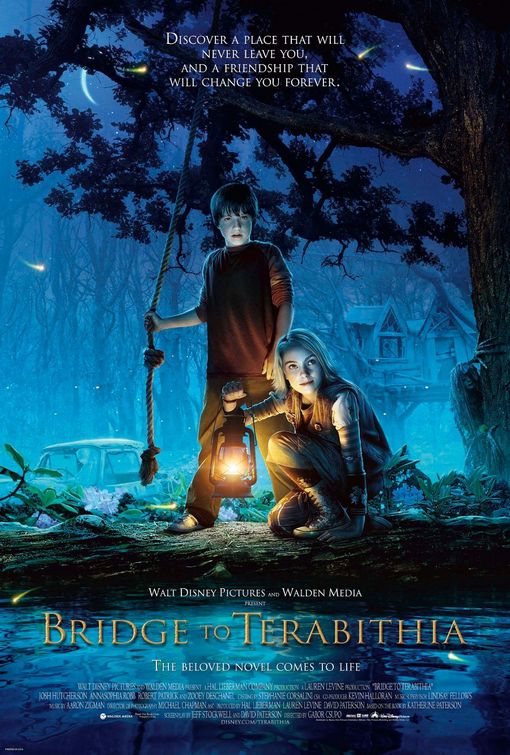
Bridge to Terabithia


This is possibly the best film I’ve seen since The Lord of the Rings.

A few weeks ago, my sister bought me this DVD, saying I’d like it.
Now the compulsory shout-out is over, I shall explain my outrageous opening statement by means of a review.

Bridge to Terabithia is the story of 12 year old Jess Aarons.  He is bullied at school and has no friends until new girl Leslie Burke arrives next door.  The two become friends and invent an imaginary magical kingdom in the nearby woods.  The film follows their adventures, which give them a means of escape from school and their families.
I won’t spoil any more for you.

In explanation of the opening statement:
  • The story is wonderfully told, completely convincing, and surprisingly gripping.
  • The acting is nothing short of outstanding.
  • The line between reality and imagination is trod perfectly and the two are very cleverly combined.
  • The moral of the story is vitally true but not overly preached.
  • The film moved me in a way that no other film, except LOTR, ever has.
The operative word in the opening statement is possibly – Stardust, Shrek 2, The Prestige and others are all contenders, but Bridge to Terabithia is right up there with them and is, I think, a more important film to watch than any of them.  If I could list five films you should watch to help you become a better person, Bridge to Terabthia would definitely be one of the five.  It might even be top.  It is truly superb - one of those films to which words cannot do justice.  Just watch it.  With tissues.

Thursday, December 31, 2009

Avatar in 3D


Last week I saw Avatar in 3D. Avatar was good, the 3D was not.

Avatar – a really good film. Reasonable plot, good script, very good acting, good action, excellent special effects. It is exciting to watch and, famously, looks brilliant. In terms of effects, it’s the biggest thing since LOTR. Motion-capture has been improved from Peter Jackson’s model so that characters interact better with the environment and facial expressions are more detailed. This was required because of the large number of animated characters that required the motion capture technique (as apposed to just Gollum in LOTR).
Critics have said that Avatar is just a chance for director James Cameron to try out new technology, and the film itself is inconsequential. This is not completely unfounded, as the film is clearly centred around the new special effects, but I don’t think the rest of the film is useless. The Middle East parallel is shamelessly obvious (humans invade an alien planet and displace the helpless to gain access to a natural resource), and the name of the resource, ‘unobtainium’, is criminal, but otherwise it is a decent film.

3D – currently very overrated. This was the first film I’d seen in 3D, and I was disappointed. It didn’t look any better than the usual ‘2D’ films. The terminology is loose here, because ‘3D’ films are no more 3D than ‘2D’ films. Both are obviously still on a flat, 2D screen, but in both it can be seen that some things are closer and some further away. What ‘3D’ does, is make things “come out of the screen at you”. The problem with this is that you think something is flying towards you, and then is slides off the side of the suddenly-very-obviously-flat screen. This just looks stupid. ‘3D’ looks no better than ‘2D’, but can look stupid and hurts your eyes. In time, I expect 3D will improve, but for now, it is very overrated.

Saturday, October 31, 2009

Trailers

This week I have been to see two films at the cinema: Creation (the story of Charles Darwin's personal life) and Up (the latest adventure from Pixar).

Before seeing these films I had seen the trailers to both.  The Creation trailer excited me greatly, the Up trailer made me think Pixar had finally run out of ideas.

I was disappointed with Creation - very little happens, there was not enough of Darwin's work and its effects on his and his wife's relationship, the science vs religion debate was barely mentioned, and that debate presented the issue as firmly either/or rather than both/and.  All the best bits of the film were in the trailer.  I would probably go as far as saying that the trailer was as good as the film.

In contrast, I was very impressed with Up - it was very well animated, laugh-out-loud funny, poignant and moving.  I felt the trailer did not do the film justice at all.

The differences between these two films and trailers really made me realise what an impact a trailer can have.  From the trailers, I was more excited about Creation than Up, but having seen the films, there is no contest as to my favourite.

On a similar note, the greatest ever trailer is the trailer for The Two Towers.  After the enormity of FOTR a year earlier and the agonising wait for the next installment, this trailer got me more excited about a film than I had ever been.

Saturday, July 11, 2009

Two thoughts on The Lord of the Rings

Last night I watched The Two Towers, having watched The Fellowship of the Ring a couple of weeks ago. I’m watching The Return of the King tomorrow.

I have two things to say.

Thing one:
When I watched these films for the first few times, I powerfully drawn in to the stories and very emotionally affected by them. Now, having seen them a scary number of times, I am understandably less emotionally affected, but my sense of awe at the beauty and majesty of the film still increases with each watching.

Thing two:
While I could explin all the reasons why this film is the greatest ever (don’t even think about debating that with me!), I want to focus on one reason – the relationships between Frodo, Sam and Gollum/Smeagol are unbelievable. Fascinating just doesn’t do it justice.
You’ve got Smeagol, once a Hobbit who has become addicted to the ring, and has been taken over by his alter-ego Gollum. Gollum has been in control for a long time but Smeagol is gaining strength through his interactions with Frodo. Both Smeagol and Gollum still desire the ring, but Gollum wants to take it now, by force, whereas Smeagol now also has a bond with Frodo and wants to serve him. (This alone would be an amazing character). Then you have Frodo, who is becoming addicted to the ring and is turning into another Gollum, but is placing his hope in the possibility of redemption he sees in Smeagol. He is trudging toward Mount Doom, but each step makes what he has to do harder. And then there’s Sam, who doesn’t trust Smeagol or Gollum, and who is watching Frodo become what Gollum is, trying to help him but being rejected as Frodo turns to Smeagol more and more.
Many people say that the Frodo/Sam/Gollum/Smeagol scenes in TTT and ROTK are boring compared to the rest of the film. I don’t understand this. Of course there is less action and fighting, but the character development is gripping. I love those scenes.

Sunday, May 24, 2009

The main reason I don't like iTunes

iTunes is completely hopeless for organising music.

iTunes has no consistency is labeling and categorising music in the player itself. For example, take the Delirious album World Service. Tracks 1-11 are by Delirious, track 12 is by Delirious and Daniel Bedingfield. If I am looking through my Delirious music on iTunes, this song is missing! It's filed under a different artist ('Delirious and Daniel Bedingfield'). Therefore I am unable to browse my Delirious collection satisfactorily (especially as Delirious have worked with several different artists, giving multiple Delirious entries in iTunes).

This problem is particularly exacerbated in film soundtracks, such as The Lord of the Rings - composed by Howard Shore, but using a total of 11 solo artists over the three soundtracks. Therefore I cannot see or play the three albums together, as they are filed under 12 different artists!

It seems to me that iTunes is aimed at listeners who generally want to listen to one track at a time and then find a different track to listen to, or listeners who only use playlists, or listeners who are happy to put their entire music collection on random.

I fit into none of these categories. For me, the best experiences of music are when I listen to a complete album, and this is the thing that iTunes is useless for.

Wednesday, May 14, 2008

The ending of The Lord of the Rings

As most people know, LOTR is by far my favourite film. Many other people seem to like it a lot too, but come up with one consistent criticism: ‘it has too many endings’. Here I attempt to explain the need for these ‘endings’ and prove that there are not too many. I believe that if a viewer thinks there are too many, he or she has missed the point. I will be looking at the epilogue from a cinematic point of view, rather than as a fan of the book.

I assume that this ‘epilogue’ begins when Frodo and Sam have run out from the Crack of Doom, having destroyed the ring, and Barad-Dur has fallen, and there is a fade to black just after Frodo says “the end of all things”.

After this climax, several things happen in sequence.

  1. Gandalf and the eagles come to collect the hobbits.
  2. Frodo awakes and is reunited with the Fellowship.
  3. Aragorn is crowned King of Gondor, is reunited with Arwen, and publicly honours the four hobbits.
  1. A short, 20 second-or-so sequence showing the hobbits arriving back in the Shire.
  2. The hobbits have drinks in The Green Dragon.
  3. Sam marries Rosie.
  4. Frodo finishes writing the book.
  5. Gandalf, Frodo, Bilbo and the other hobbits make the journey to the Grey Havens.
  6. Frodo and Gandalf farewell Sam, Merry and Pippin, and depart.
  7. Sam returns home to his family.

These scenes can be summarised as Reunion (1-2), Coronation (3), Return (4-7) and Farewell (8-10). In total, they take almost exactly 22 minutes. This is at the end of a 12-hour film, so the final section is about 1/40th of the total film time. That’s the equivalent of a 3 minute epilogue on the end of a standard 2 hour film. Not really ‘too long’, is it? Mathematically, the epilogue is clearly not overly long. The issue must therefore be that viewers expect the film to end right after the Crack of Doom climax, and are frustrated at having to wait another 22 minutes with a full bladder. There are 2 problems with this viewpoint: one is logical, the other is story-based.

Consider the alternative to the epilogue: the film ends with the fade to black after the climax. What would you think? Surely someone who has watched the films attentively would have questions such as ‘So did Frodo and Sam die?’, ‘Does Frodo ever meet Gandalf again?’, ‘What happens to the Elves?’, ‘Do Faramir and Eowyn get married?’, ‘Are Aragorn and Arwen reunited?’ If the films stops at the climax, many questions are left unanswered, and the viewer would be left unsatisfied and also, I expect, a little stunned by the abruptness: 12 hours of drama just stops. No runoff or anything. It would be like The Return of the Jedi finishing with the Emperor’s death, and no scene between Luke and Vader or celebration afterwards. Or Shawshank finishing with Red’s release and without his reunion with Andy. Some sort of epilogue is needed to let you down gently, as it were.
That’s the logical part: looking at the alternative, we see that an epilogue is needed to let us down gently and tie up the loose ends of the story.

The obvious counter-argument here is ‘ok, but why so many endings?’ Well, with such a long and complex story, there are simply a lot of loose ends to tie up. This is the story-based part.
The Reunion section is very standard – the hero meets up with his mates. Of course, in this story, there is the added moment between Gandalf and Frodo (who still thinks Gandalf is dead). They need this moment, as do Aragorn, Merry, Pippin et al. This scene brings closure on the relationships that have developed within the Fellowship and for this reason is necessary.
The Coronation is vital. It ties up Aragorn’s lost-heir story, reunites him with Arwen (who he believes has left him), and also gives a beautiful moment between him and the hobbits. It is not possible to argue against the inclusion of this scene. It finishes off so many storylines.
Many would have the film end there. But they would be forgetting that this is essentially a story about Frodo. Yes, Sam, Gollum, Aragorn and Gandalf are crucial, but Frodo is the central character. It’s his story, and it needs more closure. He cannot finish in Gondor, hundreds of miles from the home he loves and set out to save. The Green Dragon scene brings out one of Tolkein’s themes – that only those who have seen war can really appreciate what it was like. The other hobbits are oblivious to what has happened outside their borders. This scene also leads the viewer to expect a complete happy ending, which is a crucial setup for what is to come. The scene in Bag End then shows the real cost to Frodo. As Galadriel predicted, the quest does, in the end, cost him his life. Not his physical life (yet), but he loses everything that makes life worth living. That is why he leaves on the boat – he cannot live in Hobbiton any more because the Ring has had too much affect on him. LOTR is essentially about the effect of evil on the world, and that’s the effect it had on Frodo. So the Return section brings us back to Frodo, and the Shire.
Given that Frodo can’t live in Hobbiton anymore, the Farewell section is also necessary. It also happens to be possibly the most intense, bittersweet scene I have ever seen on film. The Grey Havens scene is the true climax of LOTR.

I think many people don’t completely understand what is going on in the Return and Farewell sections of the epilogue, which is why I have spent some time explaining them a bit here, though I’m sure there’s stuff in there I don’t understand either. I believe that if people understood what was happening to Frodo, they would enjoy these scenes more.

I haven’t yet mentioned Sam’s wedding or return to his family. Strictly speaking, they are not necessary as they are not part of Frodo’s personal story. However, as Sam played such a big role in the previous 12 hours, I think it’s entirely appropriate to show his eventual marriage to Rosie, especially after it becomes clear in Mordor that he thinks he will never return home. It’s good to see him happy in the end.
Personally, I would have skipped the final scene, and finished with the fade to white after the boat leaves. That way, the final emphasis is on Frodo. The filmmakers added in Sam’s return fro a desire to finish like the book, the last line of which is “Well, I’m back”. That’s their decision, and while I disagree with it, this is not a reason to say there are too many endings. It takes about 30 seconds, and reminds us that the good side did win, albeit at a cost.

So, mathematically, logically, and story-wise, I don’t think there are too many endings. Mathematically, the epilogue to LOTR is the equivalent of 3 minutes at the end of a 2 hour film – entirely reasonable. Logically, not having the epilogue would be too abrupt and would leave too many loose ends. Story-wise, the Reunion and Coronation are needed for closure and too tie up loose ends, and the Return and Farewell are actually the real end of Frodo’s story.