I rarely use this blog to just link to another site, but I found this very interesting.
http://www.relevantmagazine.com/life/current-events/op-ed-blog/25384-who-should-lead-the-church
Monday, April 25, 2011

Bittersweetness
 I recently finished reading Maggie Furey's Shadowleague trilogy. In short, it's good - pacey and gripping, with a range of interesting characters and situations and some unique features to the fantasy-world setting. I am very pleased to have read it.
ALERT: SPOILERS FOLLOW.
One (of few) complaints, however: the ending was too happy. In the last few chapters of the third book, several characters seemed about to die. While difficult to read the deaths of characters I had come to care about, it seemed appropriate that the conclusion of the story should not be without real loss. However, these characters that had been about to die, all recovered in a series of minor dei ex machina. Glossing over the problem of dei ex machina, my specific problem at the end of the Shadowleague is that not enough people died. It was not bittersweet enough. Victory was achieved...but at no cost.
I have a continual problem with unconvincingly happy endings. Bittersweet endings are so much more poignant and satisfying. This is the biggest problem I have with the Harry Potter series - not bittersweet enough. Also one of the best things about LOTR - beautifully bittersweet.
The Shadowleague is a good series and I recommend it. But it suffers in the same way as many other stories - it lacks the bittersweet ending.
Saturday, April 09, 2011
Random triplet
Three entirely unlinked comments from the past three days.
1. At cell on Thursday, we had a go at writing Psalms. Emma included in hers the phrase 'awaken me with your joy'. I liked this. The idea that we are asleep without joy until God awakens us.
2. Yesterday, I saw a Facebook status which read 'just saw Hagrid' referring to Robbie Coltrane, the actor who portrays Hagrid in the Harry Potter films. I didn't like this. It is wrong to associate actors with the parts they play so closely as to say you saw Hagrid when really you saw the actor. It's not fair towards the actor or the character. There is a danger that Coltrane becomes nothing more than Hagrid, or that Hagrid becomes defined by Coltrane's (outstandingly poor and limited) portrayal of him.
3. This morning, I listened to 'I Still Remember' by Bloc Party. This is a superbly summery song and is therefore very appropriate for our recent weather.
1. At cell on Thursday, we had a go at writing Psalms. Emma included in hers the phrase 'awaken me with your joy'. I liked this. The idea that we are asleep without joy until God awakens us.
2. Yesterday, I saw a Facebook status which read 'just saw Hagrid' referring to Robbie Coltrane, the actor who portrays Hagrid in the Harry Potter films. I didn't like this. It is wrong to associate actors with the parts they play so closely as to say you saw Hagrid when really you saw the actor. It's not fair towards the actor or the character. There is a danger that Coltrane becomes nothing more than Hagrid, or that Hagrid becomes defined by Coltrane's (outstandingly poor and limited) portrayal of him.
3. This morning, I listened to 'I Still Remember' by Bloc Party. This is a superbly summery song and is therefore very appropriate for our recent weather.
Saturday, April 02, 2011
Love Wins
 I was intending to write a review of Rob Bell's latest book, Love Wins. However, this Evangelical Alliance review is pretty much exactly what I would have written, so just read that instead.
I shall only add this, quoted from my review of The Shack:
Having said that, of course he is a heretic. Yes, the book is good, but yes, there’s also heresy in there. But so what? I doubt there’s ever been a book written (Bible excepted) that doesn’t contain some heresy. People, chill out a bit! Books are written by humans, they’re going to have errors in them! But that doesn’t mean all books are worthless! This book (and Chalke’s) are really good and well worth reading. Neither book is perfect, so you have to read them carefully, take the good stuff, and dismiss the misleading bits.
Love Shine Through

I’ve read plenty of reviews of Tim Hughes’ latest album on the internet. They are overwhelmingly positive. But they are also wrong. Some quotes:
‘the most complete album Tim has ever made’ – Louder than the music
‘the songs here are unremittingly strong’ – Cross Rhythms (10/10)
‘fills the gap left by Delirious’, ‘a wonderful offering’ – Amazon (curtrently on 5 stars, which on Amazon is an impressive feat)
‘more than just 11 fantastic worship songs, it’s an inspirational experience for worshippers everywhere’ – Eden
Now, I think Tim Hughes is great. Consuming Fire is probably by second favourite worship song ever. Maker of all things, You, Happy Day, Holding nothing back, Everything, Whole world in his hands…the list of great songs goes on. And I do not think that Love Shine Through is an awful album. Not at all. But it is nowhere near as good as many internet reviews claim. It’s ultimately a bit of a disappointment, given Tim’s previous releases.
My thoughts might (probably will) change in time, but for now, here they are.
Chris Juby summed this album up better than I ever could. He said (paraphrased) ‘there are lots of moments that make me go “yes!”, but there is not complete song that make me go “yes!”’. That is a great summary. Each song has something cool about it, but there are a total of zero great songs on there. The best song on paper is Jesus Saves, but the version on this album is hideous. It is so thin and weak, and sounds like it was recorded in a rainforest. Of the 4 minutes of the song, only 30 seconds actually works and sounds like Jesus Saves should sound. It should sound big and exciting, but most of the song is small and whimpery.
So, what are the highlights? For me, they are tracks 1, 5 and 12.
Track 1, Counting on Your Name, has an opening minute that sounds like Tim was trying to be Sigur Ros. And it sounds quite good, but it is not the way to open a worship album! After this uber mistake, there is a decent song about depending on God. I don’t agree that the phrase ‘counting on your name’ sound like gambling on God and merely hopeful that he’ll be enough. To me, that phrase means ‘depending on your name’. This is a good song, but sadly I am completely aware that part of the reason I like it is that it sounds like Matt Redman!
Track 5, All Glory, is one of the more downbeat songs on the album. Solid lyrics, and a beautifully catchy piano part. In the second half, it builds (at last, as it starts to get boring), but makes too much use of a gospel choir. Je ne suis pas un fan of this. But cut this out, and it becomes a good song. Well done Tim.
Track 12, At Your Name, is an interesting one, because it is also track 6. Track 6 is a longer and much quieter version which doesn’t really work and goes on for too long. Track 12 is much better, a genuinely good song. The one weakness is that the line in the chorus ‘Yahweh Yahweh, we love to shout your name O Lord’, sounds a little clunky. But generally, a good song. It really should have been placed at 6, and the other version put at the end.
One other track to mention – track 2, God Is Coming. A good example of what Tim does better than almost anyone else – building into and then releasing anthemic choruses. This track sounds very like much of Holding Nothing Back, his previous album. Unfortunately, the lyrics sound like an enthusiastic but ultimately inexperienced 14-year-old wrote them. They don’t say anything, they don’t go anywhere, they’re just words. Shame, because the musical side of the song is good.
I know this sounds like I’m slating the album as a whole. It’s really not that bad, it’s just really not that good either. It’s ok. It has a few really good songs, several that are mediocre, and a few that are weak. It’s not a bad alum, it’s just not as good as I’d hoped for based on Tim’s previous work, and the massacre of Jesus Saves is hard to forgive.
(Disclaimer: I’m writing this from a listener’s point of view, rather than a worship leaders point of view. I imaging worship leaders may have other comments).
Monday, March 21, 2011
Hair Reactions
There were reactions at three stages of my sponsored haircut: the announcement, the perm, and the final cut.
The reaction to the announcement was generally impressive – nearly £2000 raised for charity so far. The kids at school got really into it, understandably – seeing a teacher with a stupid haircut is worth paying some money for! Friends were superb – mental gifts of up to £100, people who I’d only met twice gave money, some people who I hadn’t seen in years popped up and shoved in a tenner. Brilliant response. The staff at school were mostly disappointing. My department gave generously, as did a handful of others, but most people just didn’t. This disappointed me as I can only put it down to laziness.
The reaction to the perm was hilarious – friends laughed a lot and gave good banter, people were keen to see photos. Kids at school couldn’t believe it – some were literally in tears, some collapsed against walls laughing, some couldn’t speak for minutes. I must admit, I didn’t expect quite such a strong reaction, but was glad to be able to entertain!
The reaction to the final cut was the most interesting. The number of people who have said ‘it looks really good’, ‘it really suits you’, or ‘you look so much younger’, or who have asked if I like it, was astounding. People genuinely think that I care what they think about how I look! I do care about how I look, but I don’t really care about what people think about how I look. Sorry. It worries me how much of a fuss people have made over my physical appearance in the last 10 days or so. Yes, I look different. Get over it. There is no need to keep commenting on it a week later, when you’ve seen me several times that week. I can understand that it looks different, but there is no need to keep saying it. Please find something more interesting about me to comment on. My hair is one of the most uninteresting things about me.
On a hair related note, thanks should go to my former housemate Simon McConway for the idea of having a competition between different hairstyles to raise money, my sister Jenny for taking all the photos, East Durham College for doing the perm for free, and James Rainey for the final cut.
Subverting Christmas
I've written about Christmas before. This post, in a way, summarises my thoughts towards it.
Christmas is celebrated on 25th December, right? It is thought that this date was chosen because a pagan festival to the sun was already celebrated on this day. Basically, Christianity subverted the festival that was already their and turned it into a Christian celebration of Jesus' incarnation.
Fast-forward a couple of thousand years. Christians now find themselves living in a culture which holds what is essentially a pagan festival on 25th December. And it needs subverting again, to turn it back into a celebration of the incarnation.
Specifics to follow sometime.
Christmas is celebrated on 25th December, right? It is thought that this date was chosen because a pagan festival to the sun was already celebrated on this day. Basically, Christianity subverted the festival that was already their and turned it into a Christian celebration of Jesus' incarnation.
Fast-forward a couple of thousand years. Christians now find themselves living in a culture which holds what is essentially a pagan festival on 25th December. And it needs subverting again, to turn it back into a celebration of the incarnation.
Specifics to follow sometime.
Tuesday, February 15, 2011
6 down...but still 3 to go
I recently reviewed three films I'd seen at the start of 2011. I've since seen three more. Here are my thoughts. Spoilers follow.
Hereafter can first, starring Matt Damon as an ex-medium. The film follows three storylines (Damon's character, a French journalist, and a bereaved child) and weaves them together. This can be done with three characters (though not with many more...Love Actually, Crash...), and all three storylines held my attention. I genuinely cared about the characters. The plots were interesting and the film was entertaining. Unfortunately, the ending was pants. Very disappointing, given the previous 90 minutes. The film tried to deal with death, and did this well in terms of the presentation of the characters' various experiences of death, but very poorly in terms of what it was trying to 'say' about death. More could have been done in this area to make some sort of a point. Not an awful film, but disappointing, as it could have been much better.
Next was Never Let Me Go. I was pretty sure it would be very good, but wasn't certain. Fear not, it was very good. Best film so far this year, eclipsing Black Swan and The Fighter (see below). The story is of three school children who discover they have been bred to be organ donors (it's set in an alternate England) and their friendships as they grow into their twenties. The acting is excellent (even Keira Knightly does a decent job), the visuals are beautiful, and the plot is brilliant. Carey Mulligan is simply incredible. This film moved me more than most do...I think the only other films to have made me cry in the cinema are the three LOTRs. Not a lighthearted film at all, not a happy ending at all...but those types of films are often the best.
Lastly, The Fighter. I'd been looking forward to this one for a while, mainly because I am in love with Christian Bale. The story is of a Boxer (Mark Wahlberg) whose career is doing down the drain, partly because his brother and coach (Bale) is a crack addict. Enter ladyfriend Charlene (Amy Adams), and it all kicks off. The three leads and supporting cast are great, the fight scenes are good, the interaction between the characters is mesmerizing (especially Charlene). The biggest let down is the presence of Wahlberg's 6-or-7 sisters, who essentially act one character, just with 7 bodies. No uniqueness, few names to get hold of. Subsequently, I didn't care about them and they annoyed me. Reducing them to 1 or 2 proper characters would have been better. But other than that, another really good film.
Tentative ranking so far:
1 Never let me go
2= The Fighter, Black Swan
4= The king's speech, 127 hours
6 Hereafter
Having been to the cinema so much recently, there are another three films to see next: The Adjustment Bureau (Bourne meets the Matrix), Fair Game (looks proper intense), and The Rabbit Hole (Nicole Kidman, woop!).
Thoughts on these will follow.
Hereafter can first, starring Matt Damon as an ex-medium. The film follows three storylines (Damon's character, a French journalist, and a bereaved child) and weaves them together. This can be done with three characters (though not with many more...Love Actually, Crash...), and all three storylines held my attention. I genuinely cared about the characters. The plots were interesting and the film was entertaining. Unfortunately, the ending was pants. Very disappointing, given the previous 90 minutes. The film tried to deal with death, and did this well in terms of the presentation of the characters' various experiences of death, but very poorly in terms of what it was trying to 'say' about death. More could have been done in this area to make some sort of a point. Not an awful film, but disappointing, as it could have been much better.
Next was Never Let Me Go. I was pretty sure it would be very good, but wasn't certain. Fear not, it was very good. Best film so far this year, eclipsing Black Swan and The Fighter (see below). The story is of three school children who discover they have been bred to be organ donors (it's set in an alternate England) and their friendships as they grow into their twenties. The acting is excellent (even Keira Knightly does a decent job), the visuals are beautiful, and the plot is brilliant. Carey Mulligan is simply incredible. This film moved me more than most do...I think the only other films to have made me cry in the cinema are the three LOTRs. Not a lighthearted film at all, not a happy ending at all...but those types of films are often the best.
Lastly, The Fighter. I'd been looking forward to this one for a while, mainly because I am in love with Christian Bale. The story is of a Boxer (Mark Wahlberg) whose career is doing down the drain, partly because his brother and coach (Bale) is a crack addict. Enter ladyfriend Charlene (Amy Adams), and it all kicks off. The three leads and supporting cast are great, the fight scenes are good, the interaction between the characters is mesmerizing (especially Charlene). The biggest let down is the presence of Wahlberg's 6-or-7 sisters, who essentially act one character, just with 7 bodies. No uniqueness, few names to get hold of. Subsequently, I didn't care about them and they annoyed me. Reducing them to 1 or 2 proper characters would have been better. But other than that, another really good film.
Tentative ranking so far:
1 Never let me go
2= The Fighter, Black Swan
4= The king's speech, 127 hours
6 Hereafter
Having been to the cinema so much recently, there are another three films to see next: The Adjustment Bureau (Bourne meets the Matrix), Fair Game (looks proper intense), and The Rabbit Hole (Nicole Kidman, woop!).
Thoughts on these will follow.
Wednesday, February 02, 2011
The Rise and Fall of Grey College Ultimate Frisbee Club
Having recently finished playing for Grey College Ultimate Frisbee Club I thought I’d try to write a history of the club so far. This will be partly my memories of the club and partly some comments on various events over the years. Therefore, it will read partly like a history and partly like a diary.
2003-2004
GCUFC was founded officially in the autumn of 2003 by Ed Gay, then a third year engineer at Grey. It was initially a club for friends to play Frisbee – at this stage it was the only college Frisbee club in Durham. Training was on Tuesday lunchtimes and Friday afternoons and consisted of simply playing Frisbee. I remember going along for the first time and being amazed at the skill and movement of some of the players, not understanding the concept of space, and being taught the forehand by Alex Wilcox. At this stage the club had about 12-15 players, about half of whom were freshers.
Later in the year, I think in the spring term, the club was invited to the ‘Northern Alliance’ tournament with DUF (Durham Uni) and Too Many Pies (Newcastle Uni). The conditions were very windy and the pitch on which we played DUF 1 was in line with the wind. This meant it was very hard to score into the wind and we only lost 6-4. I remember watching one player I was marking catch the disc in mid-air and land inside the endzone, the first time I’d seen this done.
At the end of the year, I was voted in as captain (in those days we didn’t have president/captain/treasurer roles, just one leader called the captain), and only one player, Hannah Stone, graduated.
2004-2005
The majority of players continued form the previous year and a fairly large number of freshers signed up, expanding the club to over twenty players. We started training the freshers up and soon had the basics of the game mastered – it was useful to have plenty of 2nd, 3rd and 4th years to teach the freshers. A second Northern Alliance tournament was held, which led to Grey’s first ever victory, 7-3 against DUF B. We also lost only 8-5 to Too Many Pies, an early sign of the talent in the team as we took on university level teams.
At some point during the year, I think just before Christmas, I was contacted by a girl from Chads who had set up a team there and knew of a team starting at Hild Bede. We agreed to play a mini-league in the second term. I divided the club into two teams to produce a four-team league, and Elliott Hampson and Simon Meadows stepped in as joint B team captains. Each team played three matches the following term. Grey finished top of the league, including a 30-2 demolition of Chads, while Grey B finished 3rd, behind Hild Bede.
By this time, the existence of college clubs had come to the attention of Mike Bee, DUF captain. He suggested an end of year one-day tournament and offered to organise it. This tournament happened after exams at the Shincliffe Pitches. Grey A and B were present, along with Trevs, and a Chads/Collingwood combination team known as ChadWood (despite requests for Chads and Trevs to combine to form ‘Chavs’!) Grey A won the competition, comfortably winning all their games, while Grey B finished third. Plans were made to start a more formal league the following academic year. Ben Jiggins was voted in as captain again, while Dave Grimm, Ed Gay, Sarah Walker (Senior), Alex Wilcox, John Shimmin and Kathryn Smith graduated.
2005-2006
The following autumn, seemingly thousands of freshers signed up at the freshers fair. In reality it was more like 200, and those who actually made a regular commitment to playing boosted the club numbers to over 60. These numbers stunned DUF, who had nowhere near as many players. This made us feel good. We expanded to three teams. Martin Greenbank took on the role of club and A team vice-captain, Jimi Davill was voted in as B team captain, and Paul Furley as C team captain. Jimi also became our first ever social sec. The league expanded this year, to include Collingwood A and B, Trevs, Hild Bede and Aidans.
The captains met to discuss the league rules – such rules as if a team can’t field the full 7 players, games down to 5v5 are acceptable, or that there is a hard cap of 17 points on games. One frustrating thing about later years in GCUFC was that some of the rules that had been set out in this meeting were changed and the changes were not communicated to players.
The Cs won their first game, beating Collingwood B by a point, while the Bs struggled in their first few games, losing several by narrow margins. The A team started very impressively, dominating every game and not allowing opposition teams a look in. Over Christmas, a Cuths team was formed, full of players who had been playing for DUF. They played fixtures quickly to catch up with the rest of the league and were looking strong for a while. When they faced Grey A, I was away at a family event so Martin led the team to a solid 11-6 victory, inspired by a fine Rik Smith performance. The As went on to win the league, with the Bs finishing 7th and the Cs 8th.
In the spring term, a couple of significant things happened, one personal and one on a club level. The personal one was President’s Guest Night (PGN), the main Grey social event of the second term, aimed at people who participate in college clubs and societies. It is the event where colours are given to those players who are about to graduate and have performed admirably for the club. As captain, I was asked to nominate up to three players to receive colours, and I picked Phil Gray, Simon Meadows and Sarah Walker, all of whom had been very good A team players and had also contributed to the club off-field. When it came to the night of PGN, my own name was also announced with the other three. I was at first confused at the announcement, and then it was revealed that the club, knowing I wouldn’t award colours to myself, signed a petition to the sports reps at college to allow four colours awards for the club, and to give the fourth to me. I remember walking up to the stage to receive the award and then sitting back at the table just feeling stunned. It was a fairly simple gesture from the club, but it meant a huge amount to me – it meant that my effort and hard work had been recognised, and people were grateful for it.
The other significant event, or string of events, involved relations between GCUFC and DUF. Grey A enquired about going to the university regional tournament at a 3rd DUF team, a request which DUF rejected, saying that as non-DUF players, we could not play under DUFs name. This was a reasonable response, but a disappointing one, and I think it caused some resentment in the Grey squad. In response to this, Mike Bee, now DUF A vice-captain, emailed me requesting that I encourage Grey players to go along to DUF trainings to gain skills and experience. I explained that I would do so, but that I thought Grey players were reluctant to go to DUF training because doing so would jeopardise their chances of playing in Grey A matches, due to not having attended as many training sessions as those players who hadn’t gone along to DUF sessions. The strange combination of Grey players not wanting to train with DUF and DUF not allowing Grey to play in the uni regionals was the climax of the tension between the two clubs that had been steadily building that season. In fact, several Grey players saw the creation of the Cuths team as an intentional attempt by DUF to form a team that would stop Grey A from dominating the league – a theory supported by the facts that the Cuths team was composed almost entirely of DUF players and that it disbanded at the end of the year so the players could focus on DUF.
At the end of the year was the college cup. Most teams who had played in the league attended; memorably Hild Bede brought several barbeques. I can’t remember many details about the day, though I know I threw up at one point and I remember losing in the final to the Uni/Cuths team – I think the score was about 8-5.
At the end of the year, a club constitution was written to make things more official. The roles of president and captain were separated and the role of treasurer was created. Rik Smith was voted in as president. I graduated and was given special permission by the college captains to continue playing the following year, as I would be doing a gap year in Durham working for Kings Church.
2006-2007
This season was very different for me. Although I was still playing for Grey A, I had no responsibility for the first time in two years. This took a bit of getting used to but was ultimately a really nice change. I enjoyed just being able to play, and contribute to the team, without having to be constantly thinking about tactics, drills, players, matches etc.
Rik took on the presidency and did a fine job. He took the club to the next level by organising for us to go to outside tournaments like Northern Winter League. This gave players lots of extra experience at playing at a higher level. There was still a bit of resentment felt towards DUF from last season, so it was great to almost beat them at one NWL tournament. We had an equivalent of our B team (3 As, 4 Bs and 3 Cs), and they had an almost full-strength squad. We were level at 5-5 before losing 9-6. A full Grey A would have destroyed them that day.
Back in Durham, Grey had 3 teams in the league again. Grey A were captained by Dave Dodd, the Bs by Paul Furley, and the Cs by Poul ‘Samwise’ Alexander. With no Cuths team (they were now concentrating on playing for DUF), the main threat to Grey A’s dominance looked to be Aidans and Collingwood A. We faced Aidans first, I think. I seem to remember a bit of rivalry had been building from the previous year, when meetings in the league and cup had been feisty affairs. Grey A certainly had felt that Aidans were not the most spirited of teams. When it came to the league match this year, Aidans were not happy that I had special permission to play, and we were forced to negotiate that I could play every other point. This really wound me up, especially as this was the one time my parents had come to watch me play. There was nothing we could do about it, however, so I played the upwind points and managed to help us win all of them. We won a hard-fought and bad-tempered game 7-3. The Collingwood game came later in the year, after they had already beaten Aidans, so it was basically a championship decider. This Collingwood team were really good. They’d looked excellent all season and had beaten all the other decent teams in style. We knew we were up against possibly the biggest challenge we’d ever faced in the league. We needn’t have worried. Solid handling, well-thought out tactics, 2 layout Ds in the first 2 points from Matt Knight and myself, an intense mental game and hard defence meant we won 14-0, a scoreline that no-one would have predicted. The best moment was at 6-0 when we’d been defending our line solidly for several minutes (Collingwood even thought they’d scored at one point but their player landed outside the endzone). We managed to take possession several times but had failed to get out of our own half. Then I took the disc on our line, Xander ran long, and I put up a pitch-length huck which he took down superbly, just inside the Collingwood endzone. That was the killer point. I won MVP that day – it’s one of my fondest on-pitch memories for the club.
The B team played incredibly well all season and managed to secure fourth place, beating Hild Bede on the way. An outstanding season for a B team, in a year that had seen Trevs B, Collingwood C, Johns, Mildert join the league. The C team also played well, finishing 9th out of 12 teams.
Towards the end of the year, another competition was introduced, giving the A team another chance to dominate. The College Festival of Sport was a one-day tournament featuring all Durham colleges and many sports, to find an overall college winner. I can’t remember many details about this or any other festival of sport in later years, but I do remember that these were yet more competitions in which Grey continued their outstanding, unbeaten streak at college level.
Unfortunately I can’t remember what happened to the Bs and Cs in the cup, but I do remember the As. We cruised through the early stages, beating Grey B to a pulp along the way, and met Aidans again in the final. Aidans had brought along some DUF A players to help them. I still disagree with the rule that allows DUF A players to play in the cup, but that’s another story. So, we were up against the old enemy, to regain our cup title. We went 5-1 down. We weren’t playing well at all, and then, for some reason I still am not sure of, everything started clicking. The drops disappeared, the movement was efficient, the D was tighter. We won the next point very quickly – just two passes. Rik popped the disc to me in space, Chris Rodd ran long and I picked him out. The momentum had changed and, from 5-1 down, we fought back to win 8-5. That felt really good, especially against Aidans. A great way to end the season. At the end of this season, several players such as Rik, Dave, Chris and Ed moved on to join DUF, leaving a sizeable gap in the A team that would need to be filled. Rob Balmer was voted in as the new president.
2007-2008
This year, I started a PGCE and Maters in education, allowing me to continue laying for Grey. This was a season of stability and growth, as far as I can remember. Rob did a great job as president, getting us to NWL tournaments as well as Edinburgh beginners and a variety of other outside tournaments. The club maintained 3 teams, with Alex Jamieson, Eley Haslam and Marc Etherington as the respective captains. As usual, I can’t remember much of the B and C teams’ seasons, though I don’t think they were as successful as they had been in the previous year, which was, and still is the strongest overall year in the club’s history. The A team were strong once again, with very little threat from any other team in the league or the festival sport. In the cup, the As lost in the final to another DUF-heavy Aidans team. Colours were awarded at the end of the year, but the rule about colours only being given to finalists seemed to have either disappeared or been ignored by now, something I was not happy with. I think it is a bit farcical to honour a person’s career for the club in that way before they are at the graduating stage of uni. The trend of giving colours to non-finalists continued into future years, which is a shame.
One final thing about this year – I believe Alex Jamieson to be the best captain the As ever had. He had big shoes to fill, following such a successful previous season. The As had lost a lot of quality players, but gained more good players who mostly had decent experience. It was a very hard to job to gel a new team together quickly in order to continue the dominance of previous years. But Alex did a superb job, was an excellent leader, and outstanding motivator and a good tactician. I was very proud to play under him, gutted that I never had a chance to captain him myself (he was in the C team in my final year), and touched to see him cry when he finished the job – I believe that he and I remain the only captains to be so emotionally involved in our jobs.
2008-2009
Mike White took over as president for the next year and continued Rob’s trend of entering us into lots of outside tournaments, giving great opportunities to gain experience at higher level Frisbee, and also spreading the name of Phoenix Knights, our open team name, around the country. The club shrunk in terms of numbers this year so we downsized to two teams with Sam Jones and Stefan Kemp as captains. Graduates of Grey had by this time set up an alumni team called Ashes which provided a chance for alumni to play together from time to time. I don’t know whose idea this was, but it was an excellent one. The A team this year was a strong one, which quality from top to bottom. This was the year I moved from playing handler to playing in the endzone, due to our wealth of handlers. I loved the chance to run more and to score more. I forged a lethal partnership with Jack Butters – I think we must have scored about 100 points between us that season. I scored 10 in one match, against Collingwood B. Success abounded again for the As, winning the league, cup and festival of sport again.
Links with DUF were now a lot stronger than in the past, which was both a good and bad thing. A good thing, because positive relationships with other local clubs are always good, and it helped the league to build momentum as more players from different colleges new each other. A bad thing because it pulled people away from Grey – players started going to tournaments with DUF B and therefore missing matches for their Grey teams. These conflicted loyalties caused a few rifts within Grey, mainly between the older players such as myself, Alex and Ant, and the younger ones who were now running the club. Luckily, this season the A team was strong enough to cope without a few players each weekend.
At some point, possibly this season or possibly a previous one, but after I had finished as president/captain, DUAU (the university sports team) took over the running of the league, which had previously been organised by DUF, and the cup, which had been organised by the Grey president. This made our league more official and provided better organisation, though it started to cause problems in later years.
2009-2010
The club entered the next season with our first female president. Emily had been B team captain last year and now took on the top role. Although we had had excellent female players in the past (most notably the legendary Sarah Walker (Junior)), and Eley had also been a captain, this was another step and was great to see. Grey has had a perennial problem of not having many female players and there was hope that Emily would help to change that.
Ant Bailey and Alex Pettitt were the clubs new captains. This year, I found myself in the B team. Emily acknowledged that I easily had the ability to play in the As, but said that they were concerned about the As gelling together and knew I that as a teacher I wouldn’t be able to attend Wednesday trainings. I knew this argument didn’t make sense – many of the As had played together before and it was actually the B team, consisting largely of freshers, that would have the trouble gelling. I believe it was also thought that my experience would help the B team, and that this was more of the reason for the decision. Nevertheless, it was hard to take, with my past commitment and time playing for the As.
The As dominated yet again this year, winning the treble again. The Bs enjoyed a successful season, finishing a record-equalling 4th in the league and also getting third place in the cup. And here is where I try, and probably fail, to not sound arrogant. Although there were a few decent players on the B team, I was by far the most experienced and skilful. I found it frustrating playing with inexperienced players. They did not move where I expected, they threw away what I thought to be easy throws, and they dropped lots of catches. I persevered, trying to teach and encourage as best as I could, but I desperately missed playing for Grey A and often felt like I was carrying the team.
There was also the issue that club figureheads started giving preference to DUF over Grey. This was not the same as the previous year because it now happened more often, with more players, and with more significant players. When a club’s most senior and respected players, in fact its leaders, start abandoning the club to play for local rivals, it sets a very poor example of commitment to the junior players at the club. I believe this to be, not the only factor, but the most significant factor in the downfall of GCUFC. Other factors include a shrinking in the size of the club due to, I believe, lack of community spirit and lack of players living in college, a lack of commitment from some senior players to training, and a lack of hardcoreness – training would often finish after a couple of hours rather than continuing for four just because it could. But the biggest factor was players prioritising other clubs over Grey. It comes down to why you play Frisbee. Do you play for yourself, and therefore take every opportunity to gain personal experience and skills, and play at the highest level that you can, or do you play for your club, and therefore sacrifice your personal development and opportunities to play at higher levels, in order to make your club as successful as you can? It seems that as players deprioritised playing for the club over several years, the standard of players and teams declined.
I almost left the club at the end of that season, even though I was eligible to play for one more. In the end I stayed, because I knew I wouldn’t be able to not play while still being eligible. I loved the club too much, and had invested too much in it, to give up now.
2010-2011
Mark Savage became the next president, while Jacob Hicks and George Hicks (no relation!) were the new captains. I was moved back into the A team, and it was so good to be playing with more experienced players again. However, the club was much weaker now than it had been two years previously. Many ex-Grey players were now playing with DUF, and both the A team and B team struggled to get enough players to turn up to matches. Senior players missed trainings and matches, or turned up hungover and few freshers stuck with the club.
DUAU were now causing problems too – most matches were played on the school pitches because Mary’s field was in such poor condition, but because of the nature of Frisbee and the large number of games being played, the school pitches were soon in poor condition too. This meant games had to be postponed and the fixture list became very clogged.
Then came the day that I’d always known would come, but I’d hoped it would be after I’d left. I had already received the news that, after graduating in January 2011, I could no longer play for Grey due to insurance reasons (another situation caused by DUAU). However, I intended to continue supporting the team in matches. In the first term we were still unbeaten, though looking weaker than ever before. Then in the first match of the spring term Grey A faced Johns. Not only did Grey A lose at college level for the first time ever, they were demolished by 11 points to 2.
Johns were a decent team who worked hard, but were nothing special. Grey however, were missing their captain through injury, their most experienced player (me) through ineligibility, one player through other commitments, two players who simply did not turn up, and had one vice captain returning from injury, another hungover, and a president hungover. Little could have been done about illness, injury and the ban, but the other problems showed how much the mighty Grey A had fallen.
The team that once could field a 14-strong squad of university level players, the team who would only concede a couple of points to the next best team in the league, the team that could win forty minute games in twenty minutes, the team that trained and trained and trained, 3-4 times a week, the team that balanced socialising, studies, commitments to other sports and were still fiercely loyal to the club and to each other, the team that would grab every opportunity to play an extra half hour of Frisbee, the team that refused to give up, refused to stop running, and considered every point conceded to be a personal insult from the opposition…that team was no longer. Over the past three years or so, many things have contributed to GCUFC, and particularly Grey A, being less passionate and committed than it had once been. No individual people are to blame; it has been a combination of factors. I suppose that I am the only person in the world who fully understands this, being the one person who has seen and been a part of the entire story.
As someone who has invested hundreds (possibly thousands) of hours into the club, on and off the pitch, playing over a hundred games, it is both hard and satisfying to look back over the last eight years. It is hard to see the recent decline of the club, and to think back over past difficulties and struggles. It is satisfying to remember the matches, the victories, the socials, the tournaments, but most of all the dozens of players we have produced. I am immensely proud to have played with the players I have at this great club, to have had the honour of leading some of them and coaching most of them. To anyone who has ever played for GCUFC: thankyou for your contribution to the club that means so much to me.
Update, Summer 2013:
Over the last couple of years, the club has begun to rise from the ashes. While they are not at the level of previous years, and Grey A are not head-and-shoulders the best team around, the whole 'feel' of the club has changed. Entry to outside tournaments has increased. Players seem more committed and excited about the club. There are three teams again, and probably the highest number of girls we've ever had. When I watch them play, or help with training, it feels like how the club was when it was strong. The results aren't yet as good as they used to be, nor is the quality of play, but in a way, those things are secondary. It feels like the passion is back. I'm sure that many people are to be credited for this, but some that I am aware of are John Oliver, Craig Hawes and Will White. Well done to them, and to everyone still at the club who is helping to make it great again. Keep it up guys.
Saturday, January 29, 2011
Prophecy
This post is about the theme of prophecy in my two favourite series of books: The Harry Potter series, by JK Rowling, and The Belgariad by David and Leigh Eddings. This will contain spoilers, so if you haven’t read the books but intend to, you have been warned.
Harry Potter
In Harry Potter, Harry lives the first 11 years of his life with his Aunt and Uncle because his parents die when he was a child. He was told they died in a car crash. On his 11th birthday, he discovers that they were actually killed by Lord Voldemort. He later learns that the only reason Voldemort killed them was that they were protecting their son, Harry, who was Voldemort’s real target. It is not until Harry is almost 16 that his headmaster, Albus Dumbledore, told Harry the reason Voldemort wanted to kill him in the first place. Dumbledore tells Harry of a prophecy that was made about a year before his birth:
 The one with the power to vanquish the Dark Lord approaches…born to those who have thrice defied him, born as the seventh month dies…and the Dark Lord will mark him as his equal, but he will have power the Dark Lord knows not…and either must die at the hand of the other for neither can live while the other survives…the one with the power to vanquish the Dark Lord will be born as the seventh month dies…
As Harry and Dumbledore discuss, the prophecy means that one of Harry and Voldemort will kill the other. However, Dumbledore is very clear that the prophecy is not to be viewed in a fatalistic way. As Dumbledore explains, one of Voldemort’s. spies overheard the first half of the prophecy as it was made. Voldemort believed that Harry was born with the power to vanquish him, and therefore set out to destroy him while he was only a baby. In fact, the prophecy did not specify that Harry himself was the child in question – Neville Longbottom, a contemporary of Harry’s, also fulfilled the requirements of being born at the end of July to parents who had defied Voldemort three times. But crucially, Voldemort singled out Harry, who he thought to be a greater threat. The result was that because Harry’s mother died to save him, the curse that Voldemort used on Harry did not work. Harry was ‘marked as Voldemort’s equal’ by the scar that the curse left behind. He had ‘power Voldemort knows not’ because of his mother’s sacrifice, which gave him unique protection against Voldemort and which he would not have had if Voldemort had not attacked him.
Voldemort had not heard the second half of the prophecy, so did not realise that in attacking Harry, he would hand him the weapons necessary to defeat him.
All of this means that if Voldemort had not chosen to attack Harry, Harry would not later be in a position to defeat Voldemort. It was Voldemort’s personal choice that fulfilled part of the prophecy.
Sixteen years later, Dumbledore impresses on Harry that Harry himself now has the choice to continue to fulfil the prophecy. Harry can choose to ignore the prophecy if he wishes. There is no destiny that forces him to choose one course of action or another. However, unfortunately, because Voldemort continues to follow the prophecy, he continues to hunt Harry, so in the end, it is likely that one of them will kill the other. But not because of the prophecy. Because of their choices.
The prophecy does not dictate what will happen. As Dumbledore explains to Harry, there are many prophecies that have been made and never fulfilled. Although this is not explained explicitly in the books, it seems that some wizards, such as Voldemort, view prophecies as things which must be fulfilled, whereas others, such as Dumbledore, do not. The interesting thing is that after all Dumbledore’s insistences that the prophecy only describes one possible future, rather than dictating the only possible future, in the end, Harry and Voldemort do end up battling to the death. But not because the prophecy forces them to do it; rather, because they choose to do it.
The Belgariad
The Belgariad is a less well-known series of books, so perhaps requires some introduction. Written by David and Leigh Eddings, The Belgariad is a five book fantasy series starring Garion, a simple farm boy who gets caught up in a quest to fulfil a prophecy that will decide the fate of the universe. The series has a slightly more ‘epic’ scale than the Harry Potter series, though I would class it as heroic fantasy rather than epic fantasy.
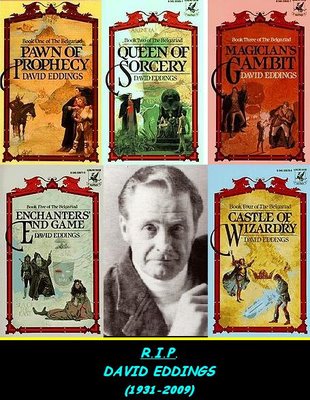 Since childhood, Garion has experienced an audible voice in his head that knows what he is thinking, is often described as ‘dry’ and certainly seems to possess a personality and a sense of humour. The voice accompanies Garion for a while, sometimes giving him advice or instructions, and then at last reveals exactly what it is. Firstly, the voice explains to Garion that originally the universe had a single purpose, a destiny. Then something happened that wasn’t intended, and from that point on there had been two possible fates of the universe – one good and one evil. The voice in Garion’s head is the consciousness or awareness of one of these fates.
Later, the voice directs Garion to a document which is the record of one of these prophecies and which states:
Behold, it shall come to pass that in a certain moment, that which must be and that which must not be shall meet, and in that meeting shall be decided all that has gone before and all that will come after. Then will the Child of Light and the Child of Dark face each other in the broken tomb, and the stars will shudder and grow dim.
It turns out that Garion is currently the ‘Child of Light’ (a title that passes from person to person at times), he embodies one of the prophecies and has to reset things to how they should be. A converging point is coming, after which only one of the two prophecies will continue to exist. Garion has a task to do, and if he succeeds, all will be right. If he fails, then chaos and destruction will follow. As a result of this, everything that exists will become a part of whichever prophecy prevails. Everyone has two possible destinies – for some people, the differences are small, for others, they are enormous. The universe, and the prophecy, has been waiting for Garion for millions of years.
So how does this work out in the story? How does this conscious prophecy interact with other characters? As already described, sometimes it talks to Garion and instructs him. Sometimes it speaks through Garion directly to other people. It is able to influence and manipulate other people directly – it is not restricted to being inside Garion’s head.
This sounds quite all-powerful, but it must be remembered that there is an alternate prophecy of equal power working against the prophecy in Garion’s head. And there are certain things that are forbidden or impossible, even for the prophecy. The prophecy itself argues that the very term ‘prophecy’ is misleading, as nothing is said about which prophecy will win or lose, and nothing about the future is certain – there are two possibilities for everything. The confrontation between the Child of Light and the Child of Dark is going to happen, the whole universe is rushing towards it, but no-one can predict the outcome.
One of the most interesting moments comes when a throwaway remark from a minor character causes an event that changes the course of the story. It is discussed that the throwaway remark might have been the only reason the minor character was born in the first place. As one character comments, ‘the prophecy leaves nothing to chance’. The prophecy does everything it can to make things ready for the final confrontation, but in the end, no-one knows what will happen until it happens.
I must admit that I am not as expert on The Belgariad as on Harry Potter. But as far as I can work out, the role of the prophecy is to direct events so that the crucial characters are ready for the confrontation when it occurs – that they have had the right experience, they know what they need to know, and they are in the right places at the right times. The prophecy cannot do anything, but it influences people as necessary to make sure everything is ready, and the alternate prophecy is doing exactly the same. Another important point is that the major characters on the ‘good’ side are aware of the prophecy and are cooperating with it, they are not merely puppets. The prophecy cannot force anyone to do anything, but it influences where it can.
Comparing the two
In The Belgariad the prophecy is a conscious personality, one of two destinies, trying to set things up to its own advantage. One of the two prophecies will be fulfilled, and one will not. If Garion’s prophecy is fulfilled, things will look very different from what will happen if it is not fulfilled.
In Harry Potter, the prophecy is a prediction that may or may not be fulfilled. The fulfilment or otherwise determines the fate of many characters. In a way, the only difference is the consciousness of the prophecies. In both stories, characters can choose to follow the prophecy or not, but the fact that The Belgariad’s prophecy is conscious means that it has much more of a direct say in what happens. This is paralleled in Harry Potter by the character of Dumbledore, who knows the prophecy and helps Harry deal with it, giving him advice and instructions. The combination of the spoken prophecy and the character of Dumbledore combine to have a similar role to that of the conscious prophecy in The Belgariad.
One of the main themes in Rowling’s books is that of fate and choice and she is clear to make the point that characters are able to make choices. The Harry Potter books are anti-fate. The Belgariad, on the face of it, seems more pro-fate, but reading carefully I see that it is not. To me, the prophecy in The Belgariad is very like some views of God. He will speak to people, try to reason with them and give them advice, even instructions, but he will not force them to do anything. He is like the chess grandmaster who can see the big picture of the game of life, can predict the opponents moves and is ready with an infinite number of counter-moves, but when it comes down to it, he lets people make their own choices. Very like the character of Dumbledore.
There are also Christian parallels in the Harry Potter ideas of fate and choice. Harry is clearly a messianic figure and just like Jesus (and Garion), he finds himself to be the potential fulfilment of a prophecy, but the prophecy does not force him into any particular course of action – he chooses his path for himself.
Harry, Garion and Jesus are all the subjects of a prophecy, they all have roles in saving the world in some way, they are all guided by seemingly omniscient characters (Dumbledore, the conscious prophecy, his Father), and they all make their own choices about how to live their lives and how (and even whether) to fulfil the prophecy made about them.
Thursday, January 27, 2011
Film ending songs
Here is a tentative stab at the best five film ending songs, i.e. the song played at the end of the film, as the credits roll. So, as yet in no particular order:
- May It Be - Enya - The Fellowship of the Ring
- Gollum's Song - Emiliana Torrini - The Two Towers
- Into the West - Annie Lennox - The Return of the King
- Now We Are Free - Lisa Gerrard - Gladiator
- The Call - Regina Spektor - Prince Caspian
The question is, is it significant that they are all performed by women?
How clean is heaven?
http://asbojesus.files.wordpress.com/2011/01/badnewsgoodnews.jpg
Do you agree with this? I think I do. I've been thinking a bit about heaven lately, and what it will be like. I anticipate a potential post entitled 'Will we poo in heaven?'

Do you agree with this? I think I do. I've been thinking a bit about heaven lately, and what it will be like. I anticipate a potential post entitled 'Will we poo in heaven?'
Tuesday, January 25, 2011
Oscars 2011
Here's who I would pick, for the categories I can be bothered to write about. Note that I haven't seen every film in the nominations, so these views are slightly flawed but as always highly opinionated.
Best Picture - Inception. I've heard that The Social Network is very good but, frankly, if it was as good as Inception, someone would have tied me down and forced me to watch it by now. I've yet to see The Fighter, and I expect that to be excellent, but I'd be amazed if it was quite as good as Inception. Black Swan is quality, but not quite that quality. The King's Speech, other than the acting, is very mediocre. True Grit is by the Coen Brothers, and is therefore rubbish.
Best Director - Christopher Nolan (Inception). Yes I know he's not nominated, but he should still win. Of those who have been nominated, I could cope if Darren Aronofsky, David O Russell, or David Fincher won. Just please, not the Coen Brothers.
Best Actor - Colin Firth. No debate.
Best Actress - Natalie Portman. One reviewer summed it up as a 'career-defining performance'. Fact.
Best Supporting Actor - Christian Bale. He is going to be awesome in The Fighter.
Best Supporting Actress - Amy Adams. She is also going to be awesome.
Best Original Screenplay - Christopher Nolan (Inception). By a mile.
Best Animated Film. Toy Story 3, obviously. Pixar should never, ever lose this award. Unless it's up against Shrek 1.
Best Adapted Screenplay - The Social Network. I've heard this is excellent.
Best Art Direction - Black Swan (not nominated, but since when did I care?)
Best Cinematography - Inception. Do not argue.
Best Sound Mixing - Inception. I said, do not argue!
Best Sound Editing - Inception. You have been warned.
Best Original Score - Hans Zimmer (Inception) You get the message? It's one of the greatest films EVER.
Best Film Editing - Inception
Best Animated Short - Day and Night (Inception was neither animated nor short)
Best Visual Effects - Inception
Totals: Inception wins 9, The King's Speech wins 1, Black Swan wins 2, The Fighter wins 2, The Social Network wins 1, Toy Story 3/Day and Night wins 2. I missed out Best Song, Best Costumes and Best Makeup, plus all the random ones.
I doubt this will come true, and therefore I will disagree, as I always do, with the award. Oh well, I'm happy knowing that Inception is amazing, The King's Speech is overrated, and the Coen Brothers are crap.
Best Picture - Inception. I've heard that The Social Network is very good but, frankly, if it was as good as Inception, someone would have tied me down and forced me to watch it by now. I've yet to see The Fighter, and I expect that to be excellent, but I'd be amazed if it was quite as good as Inception. Black Swan is quality, but not quite that quality. The King's Speech, other than the acting, is very mediocre. True Grit is by the Coen Brothers, and is therefore rubbish.
Best Director - Christopher Nolan (Inception). Yes I know he's not nominated, but he should still win. Of those who have been nominated, I could cope if Darren Aronofsky, David O Russell, or David Fincher won. Just please, not the Coen Brothers.
Best Actor - Colin Firth. No debate.
Best Actress - Natalie Portman. One reviewer summed it up as a 'career-defining performance'. Fact.
Best Supporting Actor - Christian Bale. He is going to be awesome in The Fighter.
Best Supporting Actress - Amy Adams. She is also going to be awesome.
Best Original Screenplay - Christopher Nolan (Inception). By a mile.
Best Animated Film. Toy Story 3, obviously. Pixar should never, ever lose this award. Unless it's up against Shrek 1.
Best Adapted Screenplay - The Social Network. I've heard this is excellent.
Best Art Direction - Black Swan (not nominated, but since when did I care?)
Best Cinematography - Inception. Do not argue.
Best Sound Mixing - Inception. I said, do not argue!
Best Sound Editing - Inception. You have been warned.
Best Original Score - Hans Zimmer (Inception) You get the message? It's one of the greatest films EVER.
Best Film Editing - Inception
Best Animated Short - Day and Night (Inception was neither animated nor short)
Best Visual Effects - Inception
Totals: Inception wins 9, The King's Speech wins 1, Black Swan wins 2, The Fighter wins 2, The Social Network wins 1, Toy Story 3/Day and Night wins 2. I missed out Best Song, Best Costumes and Best Makeup, plus all the random ones.
I doubt this will come true, and therefore I will disagree, as I always do, with the award. Oh well, I'm happy knowing that Inception is amazing, The King's Speech is overrated, and the Coen Brothers are crap.
Saturday, January 22, 2011
3 down, 3 to go
In the last two weeks I've been to the cinema three times.

First up was 127 Hours, starring James Franco as the bloke who goes trekking, gets trapped in a gorge for 127 hours and has to cut his own arm off to escape. The film is a good watch. The fact that the amputation scene is famous is important, because if you know it’s coming (as I did), it adds a lot of suspense the film. James Franco gives an excellent performance, especially considering he has no other actors with him for most of the film. At 90-odd minutes, it’s not excessively long, and the momentum and pace is maintained despite the relative lack of anything happening. The main weakness with the film is that, basically, nothing happens. The plot is tiny. The direction isn’t anything to write home about either. But Franco is very impressive, and the soundtrack is also very good. A decent film.

Next was The King’s Speech – about the stammer of King George VI and his struggle to overcome it. Yes, Colin Firth really is as good as people say. His performance alone makes the film worth watching. Geoffrey Rush and Helena Bonham Carter are also as brilliant as ever. The performances, as in 127 hours, are the reason to watch the film. The script is good, and very funny in places, but held back by a frankly uninteresting and very obvious plot. Therefore, massive respect to the actors for holding my attention (if a film has a poor plot, that is normally enough to turn me off). Another decent film.

Finally, Black Swan – with Natalie Portman as a ballerina cast as the lead in Swan Lake, whose paranoia develops into disturbing hallucinations. I joked before seeing the film that I was going to watch Portman go insane for two hours, but that really does summarise the film. Again, the performances are excellent, particularly Portman herself. Choreography, design, camerawork, costumes, music – all great. This film is full of suspense, a real squirmer. It’s not easy to watch at all, and frankly makes a mockery of the classification system, being a 15 despite explicit violence, language and sex. Oh, and drug use (nearly forgot). But it is really, really good. The best film so far this year.
I don’t think I’ve ever been to the cinema this regularly before. But it’s nice. And there are another 3 films I hope to see soon: Hereafter, Never Let Me Go, and The Fighter. I shall let you know my thoughts in time.
Monday, January 03, 2011
Deathly Hallows alternative version
I never thought I’d write this post, for two reasons:
1. I never thought I’d read the thing I’m about to review.
2. Even if I did read it, I never thought I’d be this positive about it.
I have just finished reading a 660-page fan-written version of Harry Potter and the Deathly Hallows. It was written before the real book seven was released, and is the author’s version of the book.
I was emailed the PDF document by a good friend who knows my love of Rowling’s books. He had received it from another friend who claimed it was ‘even better than Rowling’s version’. Of course, this is both madness and heresy, but it caught my interest enough to make me read it.
Given my very low opinion of fanfiction in general and my hatred of all things commercialising the HP books, it is very surprising that I have anything positive to say about it.
The plot generally goes down the ‘destroy the horcruxes’ line, and this quest forms the backbone of the book. Most of the fleshing out is character-based, rather than more backstory. This has pros (I always love character development), and cons (JKR is all about backstory, so this book feels incongruous with the rest).
The book is mostly from Harry’s point of view, but Ginny and Hermione (and possibly Ron, I can’t remember) get sections too. This is a nice change, but like the lack of backstory, makes it stylistically different from JKRs books, where (apart from a few lines in book 1), the only non-Harry POVs are from minor characters (Frank Bryce, the Muggle Prime Minister, Narcissa Malfoy).
The book reads in a not dissimilar way to the real HP books. The writer has a similar style to Rowling and clearly knows the characters and first six plotlines well. The meaning of Dumbledore’s phrase ‘in essence divided’ (book 5, chapter 22) is explained, for example. Characters such as Fleur, Umbridge, Pansy Parkinson and Percy are nicely developed.
A few incidents are out of character, but that is to be expected from fanfiction. Sometimes incidents are included for no bigger reason than to include them – they don’t tie in with the overall plot – here is part of the genius of Rowling – everything affects the plot. In this version, it doesn’t.
Of course, this wouldn’t be a Ben Jiggins review without some heavy criticism, so, things that were disappointingly poor:
There were no mention of the Deathly Hallows – given that this is the title of the book, this is a pretty enourmous oversight on the part of the author.
The vast majority of the character development is based around the romantic relationships of Harry, Ginny, Hermione and Ron. While mostly adequately done, this is not JKRs style and,frankly, stinks of cheap fanfiction. Other character development includes everyone neatly paring off. Vomitacious.
Some important characters get little or no page time. These include Hagrid, Neville and Luna.
Wormtail is not redeemed. He does not fulfil his debt to Harry. An idiot could have predicted that he would do so at some point and in some way, but this writer missed it.
There is no explanation of the famous ‘gleam of triumph’ (book 4 chapter 6) – this was a classic discussion point pre-book 7, but this writer just ignores it.
The manner in which the horcruxes are destroyed is too convenient. Essentially, they can all be destroyed by the creature that is guarding them. This is neat, but way to easy. And yes, I know that in the real book 7 Ron speaking parseltongue to access basilisk fangs is laughable, I agree. But I’m currently reviewing this fan-written book, not JKRs version.
The explanation given for why Dumbledore trusted Snape so much is hugely inadequate.
There is no explanation of the significance of Harry’s eyes.
One particular revelation about Dudley is appallingly ridiculous, and it’s conclusion is painfully poor.
Like in JKRs version, there weren’t enough deaths, and the deaths that there were were mostly very minor characters. It was too neat and not bittersweet enough.
Having said all that, I was mostly impressed. I didn’t realise fanfiction could have this much quality. While there were no actual jaw-dropping moments, there were several that raised my eyebrows or made me gasp. The tension and menace in certain parts of the book was real and gripping. The book was enjoyable to read.
I don’t think this will persuade me to read any more fanfiction, certainly not for the moment, and I don’t think it has enhanced my enjoyment or understanding of the original series. But it has definitely influenced my opinion on fanfiction as a concept, and for that, it was a worthwhile read.
Subscribe to:
Posts (Atom)